


Getting from Here to There: transitions in creative writing

Photo: Nur Andi Ravsanjani Gusma
by Ellen Santasiero | October 2026
Often our Forge students admit they have produced several pages of what they think is disjointed prose.
When we read their writing, sometimes we determine that they, in fact, have got two or more separate pieces started, but other times we see that they just need technique.
In writing, we get from here to there by creating what we call a “transition.” At times we want or need to change geography or era, perhaps to provide backstory—like suddenly have our main character show up thirty years earlier in 1990s Hackensack. Other times we need to change theme or point-of-view. A good transition will make sure our readers get from one place to another in a pleasurable, sense-making way. Some techniques work better in fiction; others in nonfiction.
In a piece of nonfiction where thoughts meander on the page, getting from here to there thematically can be achieved by a simple technique, as seen in a passage by Caryl Pagel in her essay “Lost in Thought.”
Pagel opens the essay with an extended description of her aimless walks around Chicago (to take breaks from writing) and the trance-like state such perambulation induces. What she really wants to muse on are photographs by Harry Callahan, whose work consists of images of 1950s women who look like they are in a trance, and which Pagel analyzes for fifteen more pages. How does she get from here to there?
On page three, she writes, “Around and around the city I’d pace … and it was during one of these walks that I recalled the work of Harry Callahan … ” (emphasis mine)
The bold text above shows how Pagel transitions from discussing her own trance-like states to those of the women in Callahan’s work. Sometimes writers can’t believe transitioning can be this easy.
In his marvelous 1933 essay “In Praise of Shadows,” Jun'ichirō Tanizaki demonstrates a technique we love. He selects an image, or a word, that appears near the end of one paragraph, and uses that same image or word at the beginning of the next.
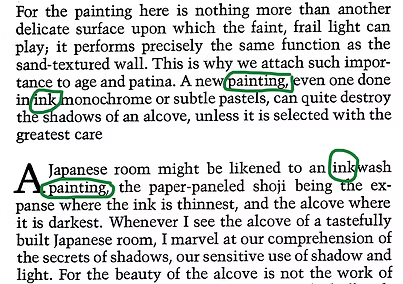
(emphasis mine) (20)
The essayist pivots from discussing artwork to discussing architecture. Not a huge leap thematically, but without this choice, the transition from one paragraph to the next might be abrupt, and, importantly, would be most unfitting in a meditation on the virtues of softness. Moreover, Tanizaki’s consistent use of this technique throughout elevates “In Praise of Shadows” to poem-like heights.
White space, almost always used in poetry, can work in prose, too. A half inch or more of space between two sections in a work of prose signals to the reader’s brain that a change is a-coming. They pause. And in pausing, they are prepared for a shift in place, time, theme, or point-of-view.
We ask students to experiment to see which technique works best for their particular vision, and that’s where the real learning happens!
If you are unsure how to move from here to there in your work, join us in January 2027. We’ll be helping writers do that, and much more! theforgewriting.com
Sources:
Pagel, Caryl. Out of Nowhere into Nothing. Tuscaloosa, University of Alabama Press, 2020.
Tanizaki, Jun'ichirō. Vintage Tanizaki: In Praise of Shadows. Translated by Thomas Harper and Edward Seidensticker, Stony Creek, CT. Leete’s Island Books, 1977.


Comments